
June 8, 2026 | By Keshaa McGurn
Financial reports that arrive late, contain unexplained reconciliation discrepancies, lack budget variance analysis, fail to separate reserve and operating funds, use vague expense categories, or omit transaction detail are all signs that your HOA financials are not board-ready.
Board-ready financials provide directors with the information they need to make decisions on assessments, maintenance priorities, reserve funding, and capital projects. When monthly reports miss critical elements or contain recurring errors, boards operate without accurate financial visibility, which can affect the association's financial health and the board's ability to meet its fiduciary responsibilities.
Georgia HOAs preparing for tax filings, audits, or financial reviews face additional consequences from inadequate reporting. Unresolved fund balance questions delay audits. Missing transaction details extend tax preparation. Recurring reconciliation errors typically require additional procedures during CPA financial statement engagements, which can extend timelines and increase professional fees.
| Sections |
|---|
| What Board-Ready HOA Financials Should Include |
| Sign 1: Late or Missing Financial Reports |
| Sign 2: Unresolved Reconciliation Discrepancies |
| Sign 3: Missing Budget Variance Reports |
| Sign 4: Unclear Reserve Fund Status |
| Sign 5: Incomplete Delinquency Reporting |
| Sign 6: Vague Expense Categories |
| Sign 7: Balance Sheet Problems |
| Platinum Financial Services CPA Board-Readiness Review |
| Board-Ready HOA Financials Checklist |
| How Poor Financials Affect HOA Tax Preparation |
| When to Contact a CPA About Financial Reporting |
| FAQ |
Board-ready monthly financial packages include six core documents that work together to show the association's complete financial position:
These documents should arrive before the monthly board meeting. The accountant should reconcile all accounts by the 10th of the following month, and the board should have time to review materials before discussing them.
Financial reports for the prior month should be ready before the next board meeting. January financials should be available for the February meeting, not the March meeting.
When reports consistently arrive after the meeting date, boards make decisions about budgets, maintenance spending, and reserve funding without current information. This problem typically points to one of three underlying causes:
Missing reports represent a more serious problem. Most HOA governing documents and the Georgia Property Owners Association Act require regular financial reporting to members. Boards that cannot produce monthly financials may face member complaints, governance challenges, or difficulty obtaining loans for capital projects.
Each bank account should reconcile to the general ledger every month. The bank statement balance, adjusted for outstanding checks and deposits in transit, should match the account balance in the accounting system.
Discrepancies that persist month after month indicate the reconciliation process needs review. This may reflect missing source documents, limitations in the accounting system, or complexity that requires additional resources to resolve.
Reserve account discrepancies deserve immediate attention because they affect the association's ability to fund major capital projects and may indicate misclassified transactions, missed contributions, or unauthorized transfers.
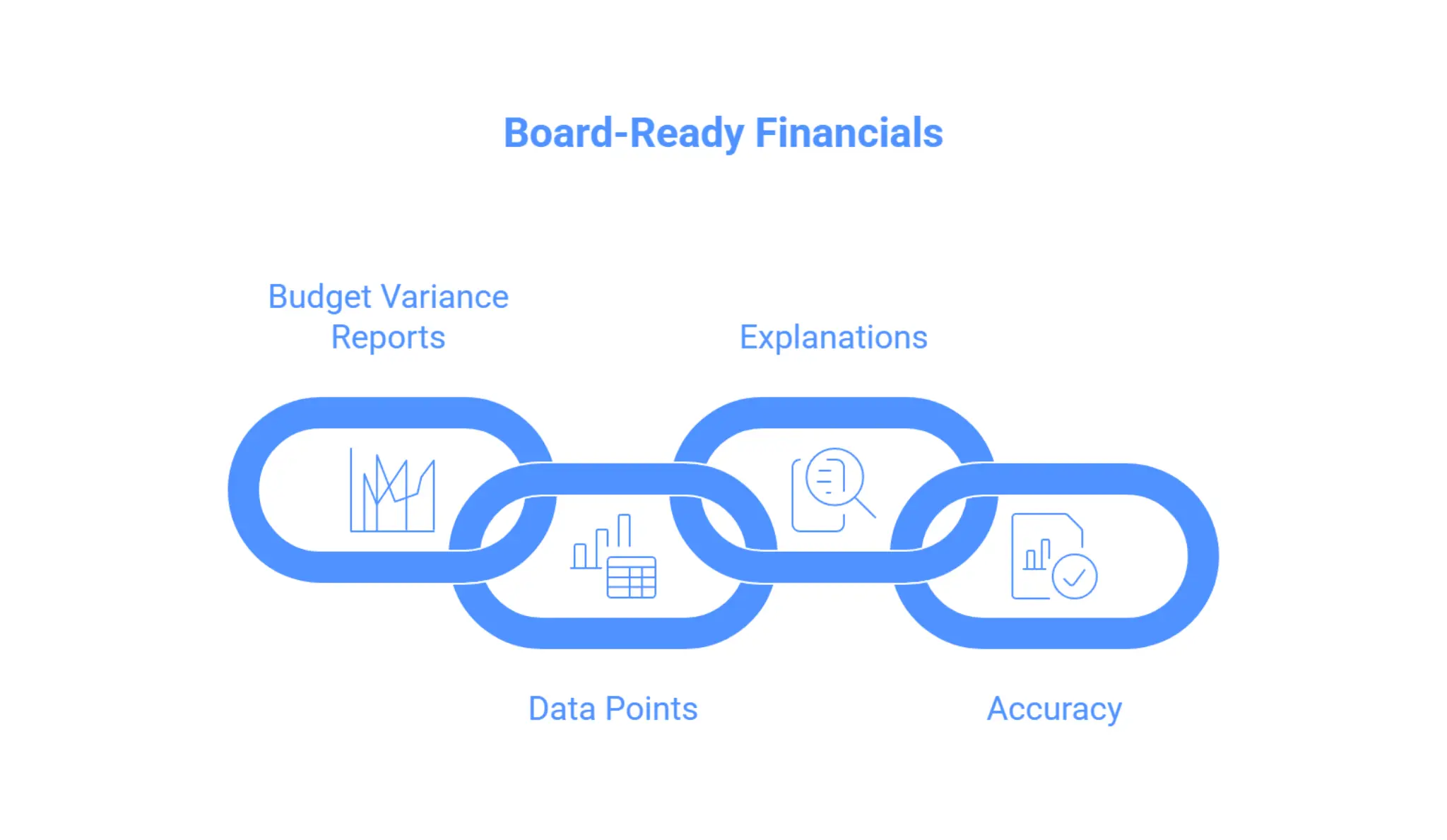
Variance reports compare actual income and expenses against the approved annual budget. Without this comparison, boards cannot assess whether spending is appropriate, identify unexpected cost increases, or determine if reserve contributions are being made as planned.
Board-ready variance reports show four data points for each line item: budgeted amount, actual amount, dollar variance, and percentage variance. The accountant should include brief written explanations for variances exceeding 10 percent.
Watch for variance reports where every line item matches the budget exactly each month. This pattern may indicate that actual transactions are not being captured separately from budgeted amounts in the reporting. The cause could range from software configuration to data entry timing, but the result obscures the true financial picture and creates reconciliation challenges at year-end.
Reserve funds require separate tracking from operating funds. Board-ready financials show the current reserve balance, monthly contributions received, expenditures made, and the funds status compared to the reserve study projection.
Common reserve fund reporting problems include:
Without a clear reserve fund status, boards cannot determine whether contributions should increase, whether a special assessment may be needed, or whether the association is positioned to handle upcoming capital projects identified in the reserve study.
Delinquency reports should identify which owners owe money, how much they owe, and how long the accounts have been past due. Reports that show only a single total dollar amount, without account-level detail, prevent boards from evaluating collection effectiveness or identifying patterns.
Effective delinquency reports include:
When the delinquency report total does not match the accounts receivable total, either the delinquency report or the balance sheet contains errors. This reconciliation difference must be resolved before either document can be trusted for board decisions.
The chart of accounts determines how expenses appear in financial reports. Generic categories like repairs and maintenance or professional fees combine very different types of spending and prevent boards from understanding where money goes.
Effective categorization separates building repairs, landscaping, elevator maintenance, pool maintenance, and parking lot repairs into distinct line items. Professional fees should be distinguished by legal, accounting, management, and engineering services. This structure lets boards compare spending to budget allocations and identify which categories drive cost increases.
Boards have the authority to direct the chart of accounts revisions. If more detailed categories would require additional fees, review the management contract or accounting engagement letter to determine what financial reporting was included in the original scope of services.
The balance sheet shows the association's assets, liabilities, and fund balances at a point in time. Specific problems indicate the accounting records need attention:
A negative operating fund balance means the association owes more than it has on hand, which indicates chronic budget shortfalls or accounting errors that require board action. Static accounts payable often indicates that unpaid invoices are not recorded in the period in which they are received. This may result from delayed invoice submission to the accounting team or process gaps in accrual recognition, and creates a financial picture that appears healthier than actual obligations.

Platinum Financial Services CPA evaluates HOA financial reporting across three areas:
All three areas should be solid before tax preparation, audit work, or major financial decisions begin. Boards that identify problems early can address them before they affect year-end financial statements or trigger findings in audit reports.
| Review each monthly financial package against this checklist: |
|---|
| Financials delivered before the monthly board meeting |
| All bank accounts reconciled with no unexplained discrepancies |
| Budget variance report includes explanations for variances over 10 percent |
| Operating and reserve fund balances are clearly separated |
| Reserve activity report shows contributions and expenditures |
| Delinquency report includes aging categories and reconciles to accounts receivable |
| Expense categories provide useful detail by service or vendor type |
| Check register or transaction detail accompanies summary reports |
| Balance sheet totals reconcile to bank balances and supporting reports |
| Year-to-date totals roll forward correctly from prior months |
If your monthly financials fail multiple items on this checklist, HOA accounting services can review your current reporting structure and identify specific improvements needed before tax season or your next audit.
Inadequate monthly reporting creates problems at tax time. CPAs preparing IRS Form 1120-H or Form 1120 must reconstruct missing information, resolve discrepancies, and verify classifications that should have been correct throughout the year.
Form 1120-H requires accurate classification of exempt function income, interest income, and expenses. Mixed funds, unreconciled accounts, and unclear expense categories typically require additional reconstruction time during tax preparation, extending engagement timelines and potentially affecting filing accuracy.
Boards that maintain board-ready financials throughout the year reduce tax preparation time, lower professional fees, and improve filing accuracy. Boards with chronic reporting problems often face higher tax preparation costs and longer engagement timelines.
Consider engaging a CPA when:
Platinum Financial Services provides HOA tax preparation, audits and reviews, and financial reporting services for Georgia homeowner associations. Our team can review your current monthly reporting, identify gaps, and work with your accountant or management company to bring financials up to board-ready standards.
Identify the underlying cause before considering changes. If capacity is the issue, the current provider may need additional resources or support. If source documents arrive late, the board should implement procedures requiring the timely submission of invoices and bank statements. If the accounting system has grown too complex, a CPA can help simplify the chart of accounts or recommend system improvements.
Discrepancies under $50 that resolve within one or two months usually reflect timing issues or bank fees that have not yet been recorded. Discrepancies above $500 that persist for more than two months indicate serious problems. Reserve account discrepancies are a signal for immediate attention because they affect the association's ability to fund major capital projects. The cause often involves timing differences, classification questions, or contribution amounts that need to be verified against the approved budget and reserve study.
Variance reports are standard financial management tools, not premium services. Any accounting system that produces an income statement can produce a variance report by adding budget columns. Review the management contract to determine what financial reporting was included in base fees. If variance reports were excluded from the original scope, the board may need to discuss expanding the engagement, adjusting the scope of services, or evaluating whether the current arrangement meets the association's reporting needs.
Yes. Form 1120-H requires accurate classification of exempt function income, interest income, and expenses. Mixed funds, unreconciled accounts, and unclear expense categories force CPAs to spend additional time reconstructing information during tax preparation. This extends timelines, increases fees, and can affect the accuracy of the final tax filing.
Yes. The board controls the chart of accounts structure that best serves the association's financial management needs. The accountant implements the board's requirements. When requesting changes, work with the accountant to revise the chart of accounts systematically and decide whether to reclassify historical transactions or implement new categories going forward.
Generally, no. Transaction details showing vendor names, payment amounts, and dates are financial information the board needs for oversight. The accountant's role is to prepare reports that support board review. Some associations restrict access to specific sensitive items, such as attorney billing details for pending litigation or items involving employee compensation, but those restrictions should be documented in board policy and applied consistently.
Yes. CPAs performing audits or reviews examine reconciliations, fund classifications, and account balances as part of standard procedures. Unresolved problems extend engagement timelines, increase fees, and may result in findings or qualifications in the final report. Boards preparing for an audit or review should engage a CPA to address known financial reporting problems several months before the audit or review begins.
If your monthly HOA financials show any of these warning signs, Platinum Financial Services CPA provides HOA accounting, tax preparation, audits and reviews, and reserve fund accounting for Georgia homeowner associations. Our team can review your current financials, identify gaps, and work with your accountant or management company to bring monthly reporting up to board-ready standards.
This article is for general information only. It should not be treated as tax, accounting, legal, or financial advice for your specific situation. Before making financial decisions or changing how your business or association handles its finances, speak with a CPA or qualified advisor one-on-one.
Keshaa McGurn, CPA, MBA, is the Founder and CEO of Platinum Financial Services CPA in Stone Mountain, Georgia. She has more than 20 years of experience in accounting, tax preparation, financial reporting, audits, internal controls, and business advisory services. Keshaa helps individuals, businesses, and homeowner associations maintain accurate records, prepare financial reports, and resolve accounting and tax challenges. She writes about HOA accounting, tax planning, financial reporting, internal controls, and business accounting strategy.
'%3e%3cg%20clip-path='url(%23clip1_1_720)'%3e%3cpath%20d='M0%205C0%203.67392%200.526784%202.40215%201.46447%201.46447C2.40215%200.526784%203.67392%200%205%200C6.10891%200.0134615%207.18354%200.386258%208.06256%201.06242C8.94157%201.73859%209.57755%202.68164%209.875%203.75H23.75C24.0721%203.77816%2024.3739%203.9189%2024.6025%204.1475C24.8311%204.3761%2024.9718%204.67794%2025%205C24.9718%205.32206%2024.8311%205.6239%2024.6025%205.8525C24.3739%206.0811%2024.0721%206.22184%2023.75%206.25H9.875C9.57755%207.31836%208.94157%208.26141%208.06256%208.93758C7.18354%209.61374%206.10891%209.98654%205%2010C3.67392%2010%202.40215%209.47322%201.46447%208.53553C0.526784%207.59785%200%206.32608%200%205Z'%20fill='black'/%3e%3c/g%3e%3c/g%3e%3c/mask%3e%3cg%20mask='url(%23mask0_1_720)'%3e%3crect%20width='25'%20height='10'%20fill='%2323439B'/%3e%3c/g%3e%3cdefs%3e%3cclipPath%20id='clip0_1_720'%3e%3crect%20width='25'%20height='10'%20fill='white'/%3e%3c/clipPath%3e%3cclipPath%20id='clip1_1_720'%3e%3crect%20width='25'%20height='10'%20fill='white'/%3e%3c/clipPath%3e%3c/defs%3e%3c/svg%3e)
Client Feedback
Our clients value clear communication, dependable service, and a financial partner who takes the time to understand their needs.
We believe strong relationships are built through consistency, honesty, and care. Many of our clients work with us year after year because they trust our guidance and appreciate our approach.

Keshaa is exceptionally professional and courteous. I highly recommend her.

Marie L Arthus
PFS rendered such excellent services to me, I will continue doing business with them. Thank you! You deserve 10 stars!

Paulette Foreman
Platinum Financial Services is truly the best in town. I’ve been getting my taxes done there since 2006 and never had any complaints.

Tamara Foreman

Platinum
Financial
Services
Platinum Financial Services is committed to professional excellence, ethical standards, and client confidentiality. Our services are delivered in accordance with applicable professional standards and regulatory requirements.
Stay Tuned


© 2026 Platinum Financial Services. All Rights Reserved


